Showing posts with label Wheat Paste. Show all posts

Thursday, March 21, 2013

Jilly Ballistic

Street Artist Biography

Stickers


Name: Jilly Ballistic

Born: Brooklyn, New York (USA) 1882 –

Most of the mass of Jilly Ballistic is comprised of oxygen, however most of her atoms are actually hydrogen. In sum, nearly 99% of her is approximately 6 elements (oxygen, carbon, hydrogen, nitrogen, calcium, phosphorus); less than a 10th of a percent are elements that can be toxic at any given time (potassium, sulfur, sodium, chlorine, magnesium).

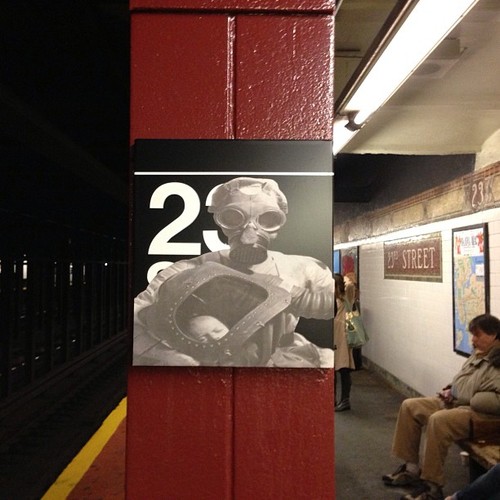
Behaviors are greatly subterranean—that is, evidence of existence has been found beneath the surface of New York City rather than above it. Most evidence is removed before proper documentation is recorded, however, we do see the following: a concise, thoughtful insertion of historical images in site-specific locations throughout the City’s metro system. As of 2013, images documented are identified between 1914 and the end of World War II. Theory suggests that this is a reflection on not only past human civilization, but also its progress over time.


There are other data on this Jilly Ballistic: modern “error messages”—or dialog boxes expressed by computer and hand held devices—have been seen pasted across less than palpable film, TV, beer and general product advertisements on platforms. The messages occur in English, tailored towards a product specifically and are—in general—very witty.


ART POLLUTION : Jilly Ballistic from DEGA films on Vimeo.
Evidence of existence also points to faux Policy Advisories. These seem to be a 21st century upgrade of idioms and “wise sayings.”

By the time this article is read, all physical evidence of Jilly Ballistic has been removed by the proper authorities. All evidence herein is based on awareness of surroundings and documentation. We must continue to document. Further evidence pending.

Follow Jilly Ballistic:

http://jillyballistic.tumblr.com/
http://www.facebook.com/thefictionist
https://twitter.com/jillyballistic
http://instagram.com/jillyballistic
http://www.flickr.com/people/jillyballistic/

Saturday, March 16, 2013

Fauxreel


photography, mural, wheat paste, wheatpasting

Street Artist Biography

Wheat Paste 

Street artist Fauxreel has earned his reputation by creating beautiful works of art from photographs. His real name is Dan Bergeron. Fauxreel studied Film and Sonic Design at Carleton University in Ottawa, Canada. After graduating, he began his career as a freelance writer for a few Toronto magazines and sought photography as another opportunity.


After a couple years, he began working as an assistant video editor for an advertising agency. During this period of time, he continued to photograph simply as a hobby. This experience also opened his perspective and began to include a variety type of design and illustration.

While working for the ad agency, Fauxreel had access to a cold press machine which was able to apply adhesion to paper mediums. Soon he began to combine his photographs into stickers and realized its potential. His desire was to be able to display and express his work to as many people as possible. At this point, street art seemed like a perfect method to deliver his message, not only was he able to attract attention, but he also had the opportunity to adjust to his surroundings and occupied space. The transition was made from regular photographic prints to using 20 lb paper.

Although there are many street artists and photographers, who have begun to work on large-scale photographic street art, few have properly adjusted their photographic presentations into the street art realm successfully. In essence, this allows photographers to obtain a different group of fans and their work is exposed on a different level.
wheat paste, art, street art, paste up

Fauxreel is attracted to the power and potential of a camera. With endless possibilities, he notes street artist JR’s work as successfully demonstrating a prime example of the photographic implementation with urban art. Not only is his work greatly admired, but it also helps to represent those in society who unrepresented by the media. H also admires other artists, like Judith Supine, who use photography in their work but not personal photographs; however, he considers their work different because they obtain their pictures from other sources.


Fauxreel, Brick by Brick from unurth on Vimeo.

Sources:

http://fauxreel.ca/

Monday, February 25, 2013

Mata Ruda

Street Artist Biography

Wheat Paste

Name: Mata Ruda

Place of Birth: San Jose, Costa Rica

Currently Living: Brooklyn, New York

Street Art Type: Wheat Paste

About: Mata Ruda is street artist currently based in Brooklyn, New York City. The intention of his work is to memorialize the nobodies, the ignored, the socially and culturally overlooked, those who in our society are consider the "others", by creating large portraits with symbols and objects (such as textile patterns, stars, moons, maps, artifacts, etc) that expose and celebrate stories that otherwise would go unnoticed.

Quote: "We can't understand what is happening to 'something' if we aren't looking but nothing is going to happen to that 'something' if we don't look deeply. That's why so many things with incredible potential go unnoticed.....because nobody bothers to look." - Alejandro González Iñárritu.

Objective: Mata Ruda is all about the magical moments, that occur constantly all around us, to him they are magical and more real than what culturally we accept as "reality". He is currently working on a series of very large portraits commemorating contemporary people (with black and brown as opposed to black on white paper) in reference to the colossal Olmec heads and indigenous stone spheres found throughout South America, Central America & Mexico. He plans on having a solo show focused on the "Colossal Series" in the Spring or the Summer of 2013. The show will be called, "Incurable Otherness"

Meaning Behind the Name: Mata Ruda = Spanish for Rue (Herb). Historically, the herb is notorious for its many medicinal AND harmful capabilities. It is also used in throughout Latin America for its spiritual powers of protection against negative energies, and warding of both foreign and internal dark spirits and it can be used to bring luck, guidance, wealth, etc...

Quote: Much of his work has to do with traveling, immigration, and adapting to new worlds/cultures. so when I read this quote by Richard Wright, I decided it was meant to be: "I was leaving the South to fling myself into the unknown...I was taking a part of the South to transplant in alien soil,to see if it could grow differently, if it could drink of new and cool rains,bend in strange winds,respond to the warmth of other suns and, perhaps, to bloom”

Definition: "Mata Ruda" literally translates to "Rough or Hardy Plant", only hardy plants can transplant to alien soil, survive, respond, and bloom..

Admiration: He wanted the name because of my admiration for the work of Pablo Neruda (originally i wanted to be either NERU or RUDA so i decided on RUDA with the word MATA in front so that it would have multiple appropriate meanings.)


More on Mata Ruda

http://mataruda.tumblr.com/

http://instagram.com/mataruda

Wednesday, February 13, 2013

Judith Supine | Street Artist Biography

Street Artist Biography

Wheat Paste
When one see's Judith Supine's name, they immediately believe the artist to be a female. However, the name is actually borrowed from his mother's maiden name.He currently works and lives in Brooklyn, New York.
Paste Up Neon Green

Supine was unable to speak until about one month after his seventeenth birthday. Interesting enough, Judith Supine spent most of his time communicating through art work. Most of the artist's work are formed in a cheap manner and often attempts to obtain free materials. Unbelievably, he often obtains his magazines from the trash, libraries, random offices, and other odd locations. He calls this process deconstruction through reconstruction. 


Wheat Paste Collage

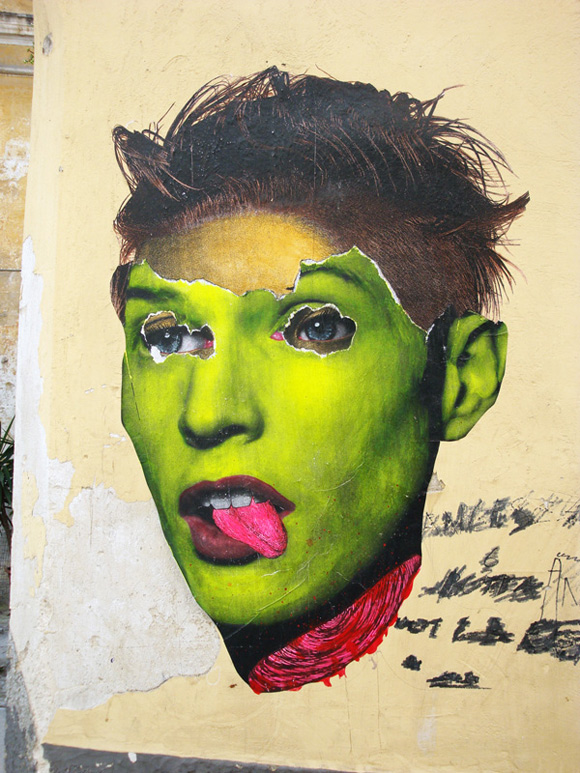
His work is then presented in a psychedelic neon acrylic perspective. Most of his creations are human skinned in a mixture of yellow and green and often include abstract patterns on dark backgrounds. These collages represent his younger days in a drug-fueled and half-conscious manner. The collage itself is something you have never seen, however, the figures, faces, and formations are seen by all everywhere. 
Wheatpaste Cigarettes

One last note, Judith Supine loves creating art that make him sexually uncomfortable.


Sources:
http://judithsupine.com/http://papermonster.net/artist.php?artist=1

Saturday, January 19, 2013

Wheat Paste

Proper Wheatpasting Techniques: How To

Wheatpasting, or wheat paste, has been around for a very long time. In fact, people have been using it as a form of adhesive for many needs; including crafts, book binding, wall stickers, and for a variety of other sources. This type of paste can be known to be similar in strenght to diluted white glue and stronger than straight glue when applied to paper.

It used today by promoters, street artists, activists, and any one willing to have some fun with minimal imagination. 

There are many methods to create wheat paste. Below is the best way to create and paste wheatpasting.

Materials to Create

  • White Flour or Whole Wheat Flour
  • Pot to Boil Water
  • 2 Containers
  • Water
  1. In order to ensure proper creation, one must start by paying close attention to detail. Begin by measuring near-exact 1:4 ratio of wheat flour to water (One cup of flower for every 4 cups of water). Place both of them in separate containers.
  2. Add water to the pot in hand and begin to boil.
  3. Once water has begun boiling, pour wheat flour in the pot. (Do not be afraid of failure once the boiling mixture boils or foams, just continue to stir.) Make sure to stir thoroughly through until the wheatpasting is very smooth and appears to feel like glue.(Destroy all flour balls and clumps in the mixture.)
  4. At this point, feel free to turn off heat and place pasting into another container. 

Materials to Paste
  • Bucket
  • Paint Brush
  • And/Or Paint Roller
  • You may also use a squirt bottle.
For proper creation technique:
  • Add some white sugar or corn starch for extra stickiness to container once paste is at room temperature.
  • Paste should be used as soon as possible for maximum efficiency. If you plan on waiting a day or two for your project, ensure you store in a refrigerator. 
  • Add copper sulphate to make the wheatpasting last longer
For proper pasting technique:
  • It is important to always put a layer in the area where one's pasting will be. Once the area is slightly wet, follow it by placing the image layer over the pasted area. Finish the process by adding another layered coat of wheat paste over the image layer.
  • Ensure wall is smooth or semi-smooth
  • Use a paint brush to clear corners or hard to reach spots- as oppose to a paint roller.
  • Add wood glue right before pasting for a more powerful stick. 1:5 ratio would work where 1 is wood glue and 5 is paste.
  • Minwax Polyacrylic works great as a strong clear finish and waterproofer. 

Other Names for Wheat Paste

  • Paste up
  • Wheatpaste
  • Wheatpasting
  • Pasting
  • Street Art Poster
  • Urban Sticker
To Lazy to Make? Shop AMAZON for SUPER cheap!


Video: Slightly different but will still work. (not as effective)


Popular Artists:
JR
Leo and Pipo
Ludo

Sources: 
http://www.wikihow.com/Make-Wheat-Paste
http://thesecretyumiverse.wonderhowto.com/how-to/street-art-101-make-wheatpaste-poster-0137642/

Warning: Use the wheatpasting techniques at your own risk. We do not encourage anyone to commit illegal acts. ALWAYS ensure what you are doing is legal and with full owner's permission.

Tuesday, January 15, 2013

Ludo

Street Artist Biography

Wheat Pasting


Ludo is a Parisian street artist.

Initially after studying sociology in Paris for three years, Ludo realized his potential in graphic designing. Not only was he more satisfied, but he also obtained money through freelance jobs. During his time in Milan, Ludo's street activity was kept affluent and his learning process continued. He did not have any major street art mentors at the time, unfortunately.

You may often see his work of art as an incredible sight. Most of his work primarily focuses on the combination of nature and human technology. More specifically, he prefers to emphasize on the way society takes nature for granted. Often, we disrespect and over-exploit it- leading human control into a vast destruction. His work focuses on our surroundings and effects all while providing a form of humility. This is the basis of his work and is sure to leave one amaze at first sight.

Ludo's primarily forms of mediums used in street art are composed of silkscreen, acrylic, pencils, scalpel, tape, and printers. This is all used for wheat pasting or paste-ups. He also currently works on street installations and sculptures by re-using objects found within the streets.

The use of green shades is used as a simple method to gain recognition. It is a well known mix that Ludo uses to convey his artwork, designs, and messages. He enjoys the idea of obtaining his very own color someday.


Sources: http://thisisludo.com/


Tuesday, December 18, 2012

Leo and Pipo

Street Artist Biography

Wheat Pasting


leo, pipo, paste up, street art, mural, wheat, paste
Leo & Pipo have created some truly memorable and unforgettable wheat-paste art and collages. Leo & Pipo were not always engaged in artistic projects. As a matter of fact, they made music for a while before they were really involved in the art scene. It was not until May 2008 that they decided to create their first piece in Paris. As with most artists, this was not as successful as expected.
leo, pipo, paste up, street art, mural, wheat, paste
Intrigued by the 1920's, 1940's, and 1950's, Leo & Pipo went on to continue creating these collages in a different manner. They approached their street art project with an innovating mind and combined old photographs with modern design and backgrounds. With this unique idea came progressive meaning and observations on to the urban scene. Family also means much to Leo & Pipo, in fact, most of their photographs revolved around a old family, friends, and flea market pictures. The individuals involved in the photographs are not necessarily important or known.


leo, pipo, paste up, street art, mural, wheat, pasteleo, pipo, paste up, street art, mural, wheat, paste, collab
The locations chosen by these artists are nothing special. Of course, Leo & Pipo always try chose new locations- locations which do not have previous artist interaction. Their work is precise and clever, often symbolizing the freedom to create and to "naturally" blend in the characters with their surroundings. The destruction of a previous piece is always inevitable. Some paste-ups last anywhere from a couple of days before they are either vandalized or removed, while other wheat-pastings may last up to a few years. This all depends on the circumstance and both artists believe once the piece is placed and pasted on to a wall then it will then belong to the streets.


As for their work being promoted, well Leo & Pipo prefer to discreetly release and paste a piece without quite promoting it. Therefore, once found, those individuals can feel the proud sensation and joy of discovering the new work of art.

leo, pipo, paste up, street art, mural, wheat, paste


Source: streetartparis.org/blog/2012/05/16/interview-leo-pipo/


Leo & Pipo’s Flickr page: http://www.flickr.com/photos/leoandpipo/
Leo & Pipo’s Facebook page: http://www.facebook.com/pages/Leo-Pipo/143959518993919


Thursday, December 13, 2012

JR

Street Artist Biography

Wheat Pasting and Photography

photography, street art, paste up, mural, eyes, JR


Who could of ever imagined that photography could be installed into streets? Well street artist JR did just the unimaginable by combining the two. Born in France on February 22, 1983, JR was just another average teenager with a passion for graffiti. However, it was not until he found a camera on the subway that his perception on street art change.


Currently, his most common method to create street art is through the use of wheat pasting and gigantic mono photographs.
paste up, wheat, street art, jr, diversity, photographs, enlarged


This artist combines powerful social statements through large portraits and murals. Not only has he won a TED Prize in the past, but he is also often compared to other politically charged art works. His art work is just one simple wish to change the world one step at a time.


His work of art brings forward common everyday materials to the light. Often introducing those who are unfortunate in the world and others who are often overseen.
JR, Street Art, TED, photograph, Enlarged

Source: http://www.jr-art.net/